Some grapes survive because they are systematically cultivated. Others survive because a family refuses to forget them. Amassi belongs to the second category. From old vines near Pozar, it made its way into a modern monovarietal bottling, carrying with it the name of Amasya and a family story of displacement and continuity.

Amassi: The rare Greek variety that returned to the bottle
A white variety from the memory of Amasya to the viticultural land of Pozar

The name that keeps origins alive
When the Thomaidis family acquired their first vineyards in 1936, Amassi was already part of the region’s viticultural life. The family recognized in the grape’s name a reference to Amasya in Pontus, the ancestral homeland of their forefathers. Thus, the variety was not preserved merely as a productive vine; it became a carrier of memory in their new homeland.
On the 3 Generations estate, the vines are trained using traditional pergolas, with some reaching up to 90 years of age. Amassi is a late-ripening variety. For this reason, the harvest is not completed in a single day, but progresses in stages through four separate passes. This approach ensures that grapes are picked at peak maturity rather than treating the entire vineyard as uniform.

The first monovarietal bottling
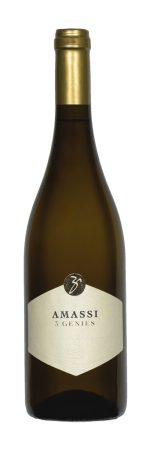
Savvas Thomaidis traveled to Italy to study viticulture and enology with his focus squarely on this specific variety. Upon his return, he became the first Greek enologist to present Amassi as a single-varietal wine in a bottle. This step carried both practical and symbolic significance: it gave the grape a recognizable name and allowed consumers to taste it without getting lost in a blend.
That bottling was the beginning, not the end, of the effort. At the winery, different ripeness levels and vinification methods are continually explored, while academic research studies clones and cultivation practices. This collaboration helps ensure that the spread of Amassi is built on a deeper understanding of the plant, rather than solely on the excitement surrounding its rarity.
What Amassi expresses in the glass
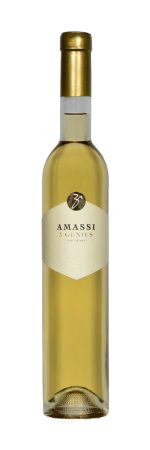
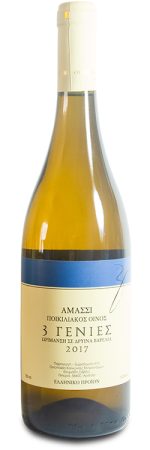
The main label is produced exclusively from Amassi and falls into the dry white wine category. The grapes grow in clay-loam soils, with cold winters and sharp temperature fluctuations in the summer. Prior to fermentation, the grapes undergo cold soak at low temperatures. The wine then undergoes temperature-controlled fermentation and rests for five months in stainless steel tanks on its fine lees.
Visually, it is pale and luminous. Its aromatic profile shifts between ripe banana, pear, and green apple, complemented by a subtle touch of vanilla. It possesses body on the palate while maintaining freshness and balance. A slight mineral impression and a lingering finish complete its character. The recommended serving temperature is around 12°C.
How to Enjoy It
Its texture allows it to stand alongside richer, slightly fatty dishes. Pasta with creamy sauces, chicken, veal, and smoked or white-sauce fish are pairings that won’t overpower its aromas. The goal is a dish with sufficient intensity that still respects the wine’s crisp freshness.
However, no technical description can substitute for a firsthand connection with the place itself. At the winery, visitors can view the traditional pergola, understand why harvesting proceeds in stages, and compare Amassi with other labels. The tasting thus gains historical and geographical context: the glass’s bouquet connects directly to old vines, family choices, and the systematic effort to rescue a rare Greek variety.
Taste Amassi at its source. A visit to 3 Generations offers more than just a new flavor—it provides the opportunity to discover how a once nearly forgotten grape regained its voice and future.